Quick answer: STAR WARS Zero Company is a single-player, turn-based tactics game set near the end of the Clone Wars. You command a squad in objective-driven tactical missions, then return to the Den to recruit, customize, build relationships, spend resources and choose which opportunities to pursue during the next Cycle.
The core loop
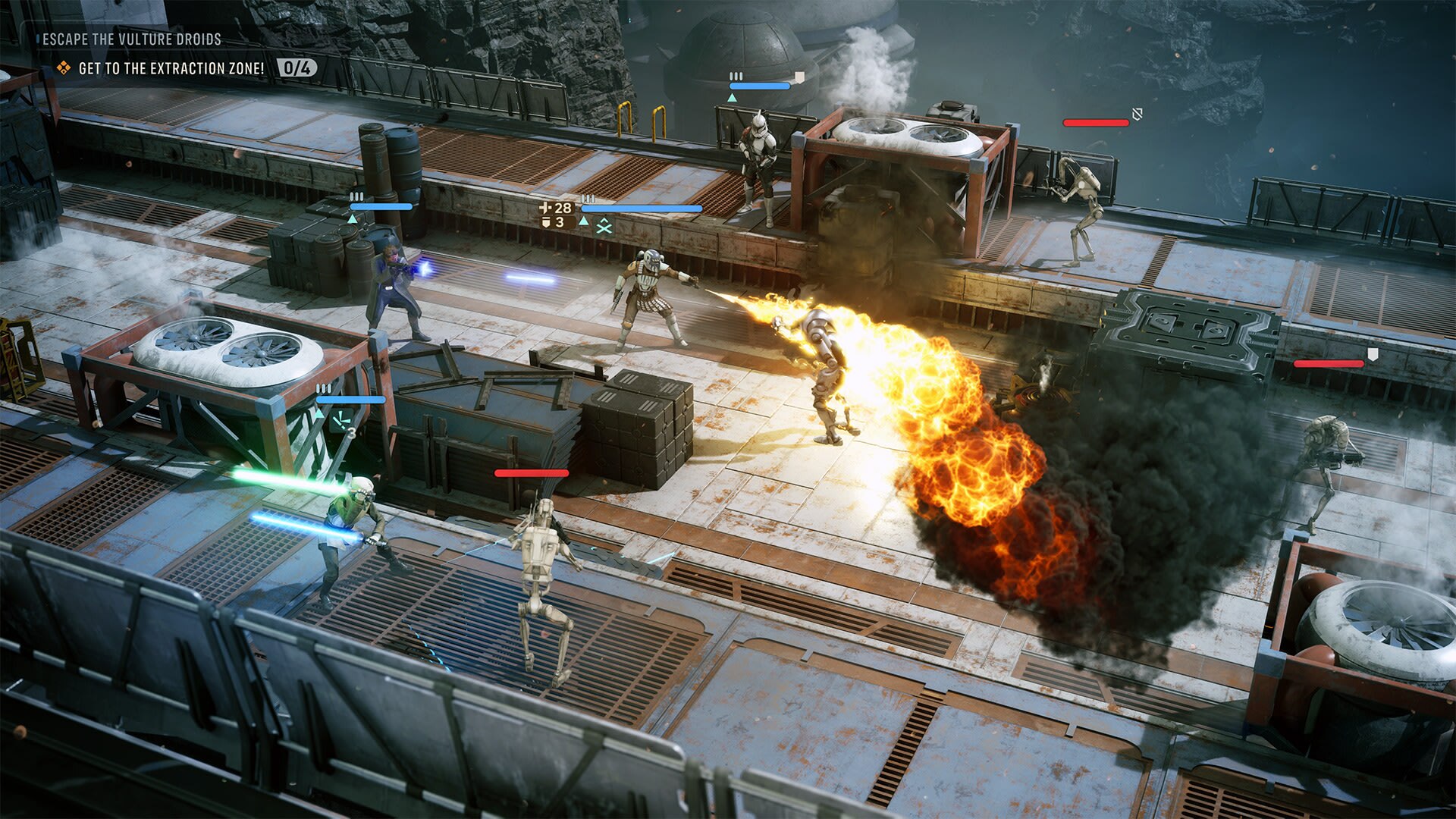
The game alternates between tactical combat and a strategic layer. In combat, Operators spend Action Points to move, shoot, use abilities, interact with objectives, call for assists, enter Overwatch or help downed allies. Between missions, Hawks returns to the Den, where the Holotable presents Operations and Tactical Missions for the current Cycle. The result is not a linear sequence of battle maps: you are repeatedly deciding which work is worth spending time, Intel and roster health on before the story moves forward.
EA describes the campaign as tactical operations and investigations wrapped around a cinematic Clone Wars story. The enemy at the center of that story is the Infinite Coil, a Separatist-aligned paramilitary cult connected to a dangerous shadow plague. Hawks leads an independent company rather than a conventional Republic unit, which gives the roster room for clones, scoundrels, droids, Jedi and custom recruits to fight together.
Three Action Points make sequencing important
Each Operator normally receives three AP. Movement and attacks have explicit costs, while abilities can use AP or other resources. Because the squad acts on the same side of the turn, you can sequence characters to create combinations: mark or expose an enemy, gain Advantage, move another Operator into a clean firing lane, then spend the resource on a Special Action.
That sequencing is one of the game's main sources of depth. A two-AP action is not automatically better than two one-AP actions; range, cover, critical chance, objective pressure and what the action enables next all matter. Weapons also have different AP patterns. For example, EA's official guide lists the Blaster Pistol at one AP per shot and the Longarm Blaster at two AP per shot, so identical three-AP turns can produce very different tactical rhythms.
Cover, range and positioning
Positioning is the foundation of most successful turns. The interface shows reachable positions and AP cost, and cover lowers exposure to return fire. Weapon Classes have optimal ranges, and attacking outside those ranges can carry a strike penalty. Sharpshooters want stable long lanes; Assault characters are designed to stay mobile at medium-to-close distance; Heavy Operators can hold exposed front-line space more safely than fragile support characters.
The objective changes what a good position means. On a rescue mission, a route toward captives can be more valuable than a perfect firing nest. During extraction, the best tile may be the one that protects an injured Operator's retreat. The game rewards players who connect positioning to the mission goal instead of treating cover as a static accuracy bonus.
Advantage and Special Actions
Advantage is a shared squad resource earned as the team damages enemies. Certain powerful actions spend Advantage instead of normal AP. This creates a second economy inside combat: ordinary attacks are not only dealing damage; they can generate the resource that enables a decisive action later.
Scout abilities make the system particularly visible. EA lists Combat Recon as a way to gain Advantage for detected enemies, while the Scout Ultimate Ambush scales with Advantage spent. Scoundrel abilities can create a guaranteed critical opportunity or enable assists. These systems encourage a "setup, then cash out" style of play rather than four independent characters each making their highest-damage attack.
Assists and Overwatch
Call for Backup lets an eligible nearby teammate join an attack. Assists can add damage and are especially valuable when your build or Bonds reward cooperation. Overwatch spends remaining AP to establish a reaction area; during the enemy turn, an Operator can fire when an enemy moves or acts inside it. Because Overwatch commits the Operator to a future reaction, it works best when the opponent's path is constrained or when advancing would be unsafe.
A practical difference between the two is timing. An assist accelerates your current turn and helps focus a priority target. Overwatch controls what the enemy can safely do on its turn. Strong squads use both, choosing between immediate concentration of fire and future zone denial.
Missions, Operations and Cycles
EA separates the strategic layer into Tactical Missions and Operations. Tactical Missions deploy a selected squad to an objective and are the game's combat layer. Official examples include Sabotage, Combat, Rescue, Retrieval and hero-focused narrative missions. Story missions can include a small third-person free-roam phase before the tactical engagement.
Operations take place through the Galaxy Map. They can provide immediate rewards, unlock further missions or operations, and present dilemmas whose choices may affect Bonds and side content. Some Operations cost Intel. Because opportunities can expire and not every task is completable, the campaign asks you to prioritize rather than clear a checklist.
A Cycle is the strategic time unit that groups these decisions. EA says each Cycle ends with a Tactical Mission selection. StarWars.com's beginner guide adds an important practical rule: deploying on a mission advances you to the next Cycle, so do the Den work you care about before departure.
The Den and strategic preparation
The Den is more than a visual hub. It houses systems that support recruitment, customization and campaign planning. You can build a roster of authored and custom Operators, tune Hawks, prepare loadouts and engage with squadmates. The official game page also emphasizes base development and the use of informants and Intel across the galaxy.
This strategic layer makes resource value contextual. Credits, Intel, Focus Points, influence and upgrade materials matter because they change what you can prepare before the next mission. A tactical victory that costs several injuries may reduce your options next Cycle; a less dramatic mission that protects the roster can leave you better positioned for a critical story deployment.
Bonds turn relationships into mechanics
Zero Company does not use a conventional romance system, but it does track relationships between squad members. Repeatedly deploying compatible characters and using supportive teamwork can improve Bonds. Higher Bonds unlock combat synergies, making relationship development mechanically relevant rather than purely conversational.
This gives roster rotation a trade-off. Keeping the same pair together can deepen their synergy, while rotating Operators protects health and develops a broader bench. Some relationships can begin negatively, so the strategic layer can also be about repairing a working relationship, not simply filling a friendship meter.
Injuries and optional permadeath
When an Operator goes down, Rally can return them to the fight, but injuries accumulate. Official guidance explains that three injuries can mean death when permadeath is enabled. EA enables permadeath by default but allows players to turn it off. The setting dramatically changes how you evaluate marginal attacks and optional objectives.
With permadeath on, campaign continuity makes survival valuable. An experienced Operator represents abilities, relationships and a role in your preferred squad. With it off, you can still face mission failure and injury pressure without permanently losing a character. Both approaches are supported by the game's settings.
Character building and replayability
Hawks is customizable in appearance, Origin, Specialization and Weapon Class, and the wider roster includes both authored and custom characters. Specializations define combat roles, while weapons change range and AP behavior. Respec later in the campaign reduces the cost of testing different combinations.
EA does not offer a traditional New Game+ at launch, but the official FAQ says some customization options unlock for subsequent playthroughs. The overall story is largely linear, yet squad composition, Operations, injuries, deaths, Bonds and tactical outcomes can make playthroughs feel different even when the central narrative destination remains consistent.
Who will like the gameplay?
Zero Company is a natural fit for players who enjoy XCOM-style squad tactics, but it does not require prior tactics experience. Its strongest appeal is the combination of readable turn-based combat with Star Wars character archetypes and a campaign where losses carry forward. Players looking for real-time lightsaber action or co-op should know that this is deliberately a single-player tactics game rather than an action RPG.