Quick answer: build around a job, not a class name. A strong Operator should have a clear range band, a predictable AP pattern and a reason to be in the squad. The templates below use confirmed Specialization and Weapon Class mechanics; Talent choices are recommendations rather than official rankings.
Build 1: Scoundrel Hawks — squad enabler
Specialization: Scoundrel
Weapon: Blaster Rifle or Blaster Pistol
Job: create guaranteed critical opportunities, assists and defense penetration.
Scoundrel Hawks works by improving the value of teammates. Use Identify Weakness before the ally with the strongest critical payoff, and use Easy Mark when the squad can immediately capitalize on the assist. The Blaster Rifle gives a forgiving medium-range first shot; the pistol preserves AP if Hawks needs to move, mark and still contribute damage.
This build rewards deliberate sequencing. Hawks should often act before the main finisher, not after. If you play every Operator independently, much of the class's value disappears. It is a good build for players who want the protagonist to feel like a commander rather than the only carry.
Build 2: Soldier Hawks — flexible first campaign
Specialization: Soldier
Weapon: Blaster Rifle
Job: solve mixed encounters without a specialized setup.
Soldier is EA's straightforward beginner recommendation. Rocket Strike handles groups, Brutal Strike gives a melee control option, and the passives support both primary blaster and grenade use. The rifle's one-AP first shot gives the class room to move or use an ability before committing more AP.
This build is less dependent on a specific map. Use it when you do not yet know which encounter types you prefer or when the rest of the roster already contains highly specialized characters. Later, respec can move Hawks into a narrower class without forcing a restart.
Build 3: Sharpshooter — long-range control
Specialization: Sharpshooter
Weapon: Longarm Blaster
Job: remove priority targets from a stable back-line position.
EA directly pairs Sharpshooter and Longarm for long-range play. Zero In rewards staying planted, Precision Shot provides an always-hit high-impact option, and Pick Them Off improves Overwatch. The weapon's two-AP shot cost means the build needs good pre-positioning; if the Operator must spend most of the turn relocating, output collapses.
Pair this build with a front-line character who can stop enemies from reaching the sniper and with a Scout or Scoundrel who can improve target quality. Do not send the Sharpshooter forward simply because the rest of the squad advanced.
Build 4: Gunslinger Repeater — offensive burst
Specialization: Gunslinger
Weapon: Repeater
Job: turn a protected firing position into repeated damage.
EA recommends Gunslinger and Repeater for damage-focused play. Open Fire and Onslaught reward turns centered on shooting, while the Repeater rewards committing AP into Rapid Fire. The build is strongest when another Operator has already solved cover, targeting or control problems.
The weakness is obvious: a turn spent moving is a turn not fully exploiting the weapon. Use a mobile teammate to trigger objectives or draw pressure while the Gunslinger maintains a reliable lane.
Build 5: Gunslinger Pistol — mobile cleanup
Specialization: Gunslinger
Weapon: Blaster Pistol
Job: finish weakened targets while preserving AP.
The pistol costs one AP per shot, and Quick Draw can refund AP when it scores a kill. That creates a natural cleanup loop. Let heavier attacks bring enemies into finishing range, then use the Gunslinger to remove one or more wounded targets efficiently.
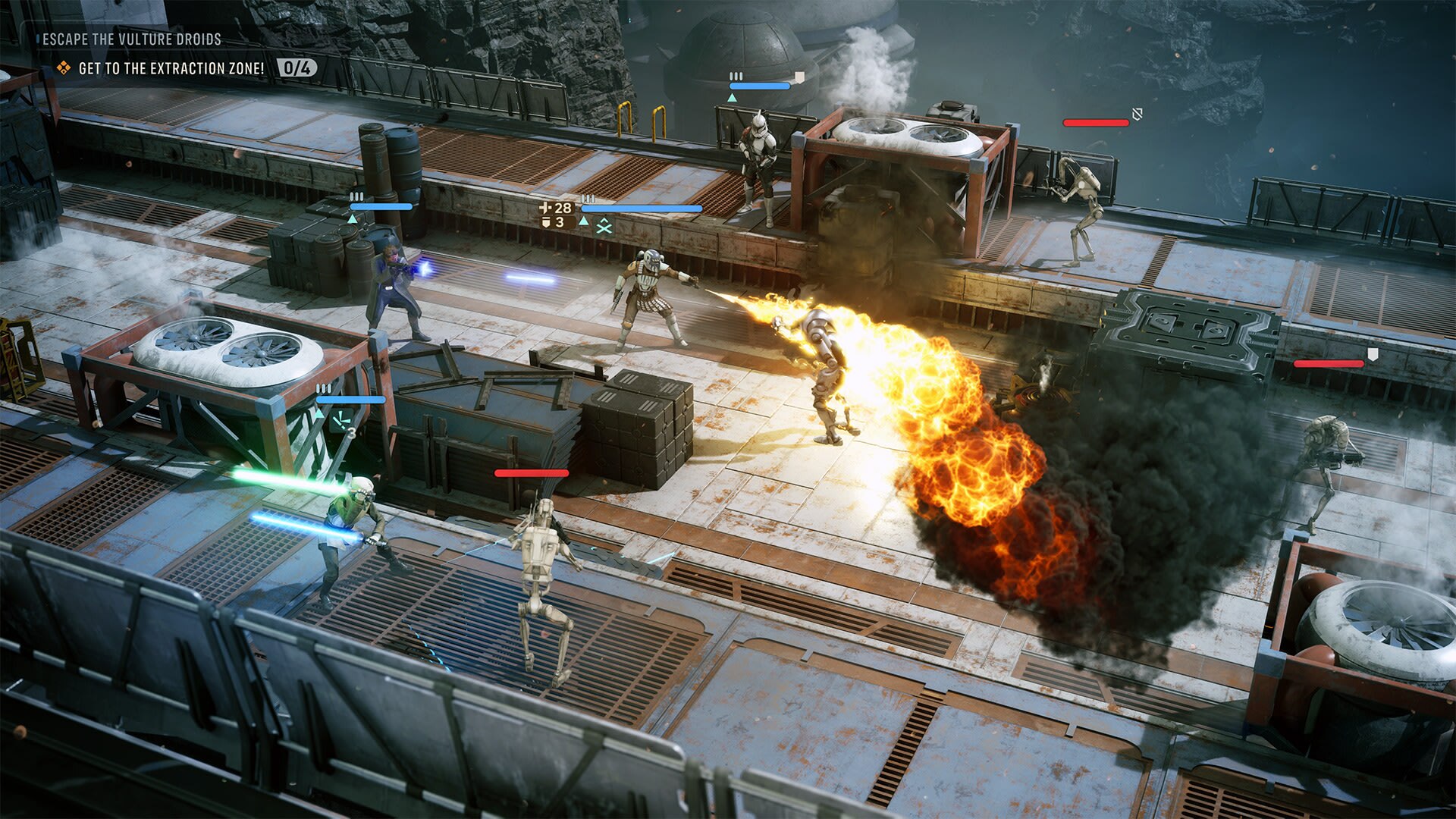
This build is not about the largest single hit. It is about avoiding wasted damage and using AP exactly where needed. It is particularly useful on missions where the squad must keep moving toward a rescue, sabotage target or extraction zone.
Build 6: Heavy Repeater — anchor and threat magnet
Specialization: Heavy
Weapon: Repeater
Job: absorb pressure, taunt enemies and punish them from a stable position.
Heavy combines durability with enemy attention control. Bulwark and the taunt passives make it possible to protect more fragile Operators. The Repeater complements the desire to hold a location and devote AP to attacks. This build is valuable when your Sharpshooter, Medic or tactical support keeps being forced out of position.
Do not mistake toughness for invulnerability. The Heavy still benefits from cover and support. Its job is to make enemy attacks predictable and survivable, not to stand alone in the center of the map indefinitely.
Build 7: Medic support — permadeath insurance
Specialization: Medic
Weapon: Blaster Rifle
Job: keep organic squadmates active and reduce the strategic cost of injuries.
Medic's Morale, Combat Stim, improved Medpacs and Rally bonuses make it a strong choice for campaigns where injuries matter. A Blaster Rifle keeps the Medic useful at medium range without demanding that they approach every enemy. Because Medpacs do not work on droids, this build is more valuable in a squad with organic Operators than in a droid-heavy composition.
The support turn should be proactive. Buff an ally before the key attack, not after the battle is already decided, and keep the Medic positioned so Rally does not require an impossible sprint.
Build 8: Scout Advantage engine
Specialization: Scout
Weapon: Blaster Rifle
Job: generate Advantage, apply Spotted and improve the team's follow-up attacks.
Scout's Combat Recon can generate Advantage from detected enemies, while The Spotter makes damaged targets easier for the squad to hit through range or smoke penalties. This build becomes stronger as the rest of the team gains expensive Special Actions worth funding.
Treat the Scout's turn as setup. The best result may be a modest direct hit that makes three subsequent actions better. If you only compare end-of-mission personal damage totals, you will undervalue this role.
How Talents fit into builds
Talents provide another layer on top of Specialization. Post-launch guide testing has identified options such as A Life of Labor, Anticipation and Grit as broadly useful choices, with more specialized Talents fitting narrower roles. Because recruitable Operators can later change Talent and Specialization, prioritize a coherent role over chasing a permanent "perfect" recruit.
For authored story characters, be more careful: their Talent identity is more fixed, and respec behavior differs from fully custom recruits. Use the Talent page as a role-matching guide rather than blindly copying one tier list across every character.
Squad-building rules that matter more than a tier list
- Cover at least two range bands so one map type does not invalidate the entire squad.
- Bring a plan for recovery if permadeath is enabled.
- Include at least one way to create better attacks: Vulnerable, Spotted, assists, control or Advantage.
- Avoid four Operators who all need to stand still and spend the full turn shooting.
- Use the mission objective to decide who deploys; a mobile objective run and an Extreme combat mission may want different squads.
- Respec when a role is not working instead of forcing a build because it looked strong on paper.